What Is the Scientific Name for a Whitetail Deer? Habitat, Subspecies & Fascinating Facts
If you spend any time in deer camp, wildlife documentaries, or out in the woods during hunting season, you've heard the name "whitetail" countless times. But what exactly is a whitetail deer from a scientific standpoint? What is the scientific name for a whitetail deer, and where does a whitetail deer live in the wild?
The white-tailed deer (Odocoileus virginianus) is North America's most studied - and arguably most beloved - big game animal. Its range stretches from the boreal forests of Canada to the tropical lowlands of Peru, encompassing dozens of subspecies that vary dramatically in size, coloration, and antler development.
This guide covers the taxonomy, geography, biology, and conservation story of the whitetail deer. Whether you're a biology student, a curious hunter, or just someone who wants to understand the animal behind those iconic deer designs, you'll find everything you need here.

The Scientific Name for a Whitetail Deer - Odocoileus virginianus
The scientific name for a whitetail deer is Odocoileus virginianus. This binomial nomenclature was first assigned by German naturalist Eberhard August Wilhelm von Zimmermann in 1780, and it remains the accepted classification to this day.
At a glance, this name tells you two important things: the genus (Odocoileus) groups the whitetail with its closest relatives, while the species epithet (virginianus) points to where the type specimen was first described - the colony of Virginia on the eastern seaboard of North America.
Etymology - What Does "Odocoileus virginianus" Mean?
Breaking down the name reveals its Greek and Latin roots:
- Odo- - from the Greek odṓn (ὀδών), meaning "tooth"
- -coileus - from the Greek koîlos (κοῖλος), meaning "hollow" or "cavity"
- virginianus - Latin for "of Virginia"
Put together, Odocoileus roughly translates to "hollow-toothed" - a reference to the distinctive dental morphology of these deer, particularly the structure of their premolars and molars adapted for grinding fibrous plant material. The species name virginianus honors the region where European naturalists first formally documented the animal.
Taxonomy - Where Whitetails Fit in the Deer Family
Understanding the full taxonomic classification helps place the whitetail within the broader deer family (Cervidae):
| Rank | Classification |
|---|---|
| Kingdom | Animalia |
| Phylum | Chordata |
| Class | Mammalia |
| Order | Artiodactyla |
| Family | Cervidae |
| Subfamily | Capreolinae (New World deer) |
| Genus | Odocoileus |
| Species | Odocoileus virginianus |
As a member of the subfamily Capreolinae, the whitetail is a "New World deer" - meaning it evolved in the Americas rather than Eurasia. This distinguishes it from Old World deer like red deer (Cervus elaphus) and fallow deer (Dama dama).
The genus Odocoileus contains only two extant species: the white-tailed deer (O. virginianus) and the mule deer (O. hemionus). Despite their close relationship, these two species differ in several fundamental ways.
Whitetail vs. Mule Deer - Key Scientific Differences
Though both belong to the same genus, whitetail and mule deer exhibit clear distinctions:
- Antler structure: Whitetail antlers grow from a single main beam with tines branching upward. Mule deer antlers fork dichotomously - each branch splits again, creating a "Y" shape.
- Tail display: Whitetails raise their white tail (flagging) when alarmed. Mule deer have a smaller, less conspicuous tail with a black tip.
- Body size: Mule deer tend to be larger, with larger ears (hence the name "mule").
- Escape behavior: Whitetails sprint with a bounding gait and flag their tail. Mule deer use a distinctive "stotting" or "pronking" gait - all four legs pushing off simultaneously.
- Geographic separation: While ranges overlap in the western United States and Canada, whitetails dominate the eastern half of North America, while mule deer are primarily western.
These differences are important for hunters and wildlife enthusiasts alike. If you're looking for gear that honors both species, our hunting shirts collection features designs inspired by the full spectrum of North American game.

Where Does a Whitetail Deer Live?
The whitetail deer range is one of the most extensive of any land mammal in the Western Hemisphere. Where does a whitetail deer live? Practically everywhere from subarctic Canada to the highlands of Bolivia - making it one of the most geographically adaptable ungulates on the planet.
Geographic Range (Canada to South America)
The whitetail deer's natural distribution covers an enormous swath of the Americas:
- Canada: Southern provinces from British Columbia through the Maritimes, though not the high Arctic
- United States: All 50 states - including introductions to Hawaii and Alaska
- Mexico: Widespread throughout the country, with several endemic subspecies
- Central America: Guatemala, Belize, Honduras, Nicaragua, Costa Rica, and Panama
- South America: Colombia, Venezuela, Guyana, Suriname, French Guiana, Ecuador, Peru, and Bolivia
No other deer species has such a broad latitudinal distribution. The whitetail deer habitat spans tropical rainforest, temperate deciduous forest, boreal forest, desert scrub, agricultural land, and even heavily suburbanized areas - a testament to remarkable behavioral flexibility.
Preferred Habitat Types (Forests, Edge Country, Suburban Areas)
Within this vast range, whitetails gravitate toward specific habitat features:
- Deciduous and mixed forests: The classic whitetail environment. Hard mast (acorns, hickory nuts) provides critical fall nutrition, while dense understory offers cover.
- Edge habitat: Whitetails are quintessential "edge species" - they thrive where two habitat types meet, such as forest-field boundaries. These edges provide both food (open areas) and security (forest cover).
- Agricultural landscapes: Corn, soybeans, and alfalfa fields are essentially high-protein buffets for whitetails. Deer populations often reach their highest densities in farming regions.
- Suburban and urban areas: Perhaps the most surprising whitetail deer habitat is your own backyard. With no natural predators, abundant ornamental landscaping, and warm microclimates, suburban deer populations have exploded across the eastern U.S.
"Whitetails are arguably the most adaptable large mammal in North America. They've colonized habitats that no deer was 'supposed' to live in - from the Florida Keys to the Canadian prairie edge." - Dr. Karl V. Miller, Deer Ecology Researcher
How Whitetails Adapt to Different Environments
What makes the whitetail deer range so expansive is the species' ability to shift its behavior and physiology to match local conditions:
- Coat change: Northern whitetails grow a thick, hollow-haired winter coat for insulation, then shed to a thinner, reddish summer coat. Southern and tropical subspecies show less dramatic seasonal molt.
- Body size variation: Bergmann's Rule applies strongly - northern whitetails (e.g., O. v. borealis) can weigh 200-300+ lbs, while Key deer (O. v. clavium) tip the scales at just 55-75 lbs.
- Dietary flexibility: Whitetails are opportunistic browsers, shifting between woody browse, forbs, grasses, agricultural crops, and even aquatic vegetation depending on availability.
- Activity pattern shifts: In areas with heavy human pressure, whitetails become primarily nocturnal. In undisturbed areas, they're crepuscular (most active at dawn and dusk).
This adaptability is part of what makes the whitetail such a compelling species - and such a popular subject for wildlife-inspired apparel that celebrates North American nature.

Whitetail Deer Subspecies - How Many Types Exist?
One of the most debated topics in cervid biology is how many whitetail deer subspecies actually exist. Different authorities recognize different numbers, but the most commonly cited classification identifies 38 subspecies of Odocoileus virginianus, split between North American and Central/South American groups.
Recent genetic studies have suggested that some of these subspecies designations may represent clinal variation (gradual geographic change) rather than discrete taxonomic units. However, for practical purposes - hunting regulations, wildlife management, and conservation - the subspecies framework remains useful.
North American Subspecies
The North American whitetail deer subspecies include some of the most well-known and heavily hunted populations:
| Subspecies | Scientific Name | Region | Notable Traits |
|---|---|---|---|
| Northern Whitetail | O. v. borealis | Canada, northern U.S. | Largest body size, massive antlers |
| Dakota Whitetail | O. v. dakotensis | Dakotas, Montana, Wyoming | Large-framed, pale winter coat |
| Columbian Whitetail | O. v. leucurus | Pacific Northwest | Medium size, darker coat coloration |
| Key Deer | O. v. clavium | Florida Keys | Smallest subspecies, endangered |
| Carmen Mountains Whitetail | O. v. carminis | West Texas | Small-bodied, desert-adapted |
| White-tailed Deer (Nominate) | O. v. virginianus | Eastern U.S. | Type specimen, medium-large |
The nominate subspecies (O. v. virginianus) - the one first described by Zimmermann - represents the classic eastern whitetail that most hunters and wildlife photographers know. States like Pennsylvania, Wisconsin, and Texas consistently produce trophy-class bucks from this lineage.
For hunters who want to carry that eastern whitetail heritage into everyday wear, our Deer Skull T-Shirt captures the rugged spirit of North American big game

Deer Skull T-Shirt - Shop at Fathom Thread
Central & South American Subspecies
South of the U.S.-Mexico border, the whitetail deer subspecies become smaller, more tropical, and less studied. Some notable Central and South American subspecies include:
- O. v. mexicanus - Central Mexican Plateau; medium-bodied, well-adapted to semi-arid conditions
- O. v. veraecrucis - Veracruz and surrounding Gulf Coast tropical forests
- O. v. yucatanensis - Yucatán Peninsula; smaller frame, adapted to tropical scrub
- O. v. nelsoni - Southern Mexico and Guatemala; critically endangered due to habitat loss
- O. v. curassavicus - Curaçao and nearby Caribbean islands; small insular population
- O. v. goudotii - Colombian Andes and Venezuela; high-elevation adaptation
- O. v. peruvianus - Peruvian coastal and montane regions
- O. v. truei - Costa Rica and Panama; among the southernmost populations
These tropical subspecies are often less conspicuous than their North American cousins, with less seasonal coat change, smaller antlers, and more year-round breeding activity (as opposed to the strict autumn rut of northern populations).
Regional Size and Antler Differences
The most visible white-tailed deer facts about subspecies variation involve body size and antler dimensions:
- Body weight: Northern bucks (O. v. borealis) routinely reach 200-300 lbs dressed, while Key deer (O. v. clavium) weigh just 25-40 lbs dressed - a nearly 10:1 ratio.
- Antler spread: Trophy whitetails from the Midwest and Canada can produce racks exceeding 200 inches on the Boone & Crockett scale. Central American subspecies rarely exceed 120 inches.
- Ear size: Tropical subspecies tend to have proportionally larger ears - likely an adaptation for heat dissipation in warm climates (Allen's Rule).
- Coat color: Northern whitetails develop a thick gray-brown winter coat, while tropical subspecies maintain a more consistent reddish-brown pelage year-round.
Whitetail Deer Biology & Behavior
Beyond taxonomy and geography, the whitetail deer is a biological marvel. Its sensory systems, digestive physiology, and reproductive strategies are all finely tuned to survival in diverse environments.
Diet and Digestive System (Ruminant Biology)
Whitetails are ruminants - meaning they have a four-chambered stomach (rumen, reticulum, omasum, and abomasum) that allows them to ferment and break down cellulose-rich plant material that most mammals cannot digest.
The whitetail diet includes:
- Woody browse: Twigs, leaves, and bark of shrubs and young trees (especially in winter)
- Forbs: Broadleaf herbaceous plants (a primary summer food source)
- Mast: Acorns, hickory nuts, beechnuts - the most critical fall food for fat accumulation
- Agricultural crops: Corn, soybeans, wheat, alfalfa (where available)
- Fungi: Mushrooms and truffles, especially in late summer and fall
- Fruits and berries: Persimmon, apple, blackberry, and other seasonal fruits
A whitetail deer consumes approximately 6-8 lbs of food per day (dry matter equivalent), though this can increase significantly during the pre-rut and pre-winter periods when fat accumulation is critical.
Senses - Vision, Hearing, and Smell
Understanding whitetail sensory biology is essential for any hunter or wildlife observer:
- Vision: Whitetails have approximately 310° of binocular vision (compared to ~180° for humans). They see well in low light thanks to a reflective layer called the tapetum lucidum. However, they have limited color perception - they see blues and yellows well but struggle with reds and oranges (this is why "blaze orange" is effective for hunter safety).
- Hearing: Whitetail ears can rotate independently 180°, allowing them to pinpoint sound sources with remarkable precision. They can hear frequencies up to approximately 30,000 Hz - well above the human range of ~20,000 Hz.
- Smell: The olfactory system is the whitetail's dominant sense. They possess approximately 375 million scent receptors (compared to ~6 million in humans). Wind direction is the single most important factor in whitetail hunting because of this extraordinary olfactory capability.
Reproduction and Lifespan
Whitetail reproduction centers around the annual rut - a breeding season triggered by photoperiod (day length) changes in the fall:
- Rut timing: Peaks in October through December, varying by latitude (earlier in the north, more spread out in the south)
- Gestation: Approximately 202 days (about 6.5 months)
- Fawning: Most fawns are born in May and June
- Litter size: Typically 1-2 fawns for first-time does; twins are common in healthy, mature does; triplets occur in optimal conditions
- Sexual maturity: Does can breed at 1.5 years; bucks typically don't breed successfully until 2.5+ years
- Lifespan: Wild whitetails live 4-6 years on average (heavily hunted populations) to 10-12 years in protected areas. Captive whitetails can exceed 15 years.
The Famous White Tail - Why They Flag
The behavior that gives the species its common name is called "flagging" - when a whitetail raises its tail to expose the bright white underside when alarmed. This serves multiple functions:
- Alarm signal: Warns other deer in the area of danger
- Follow-me signal: Fawns and other deer can track the flashing white tail through dense vegetation during flight
- Startle display: The sudden flash of white may momentarily startle or confuse predators
- Intraspecific communication: The intensity and duration of flagging may convey information about the level of threat
This iconic behavior is captured beautifully in our Deer Skull Camo Hoodie - designed for hunters who want to carry that wilderness spirit everywhere. Not sure which size to grab? Our hoodie sizing guide covers exactly how to measure yourself before ordering

Deer Skull Camo Hoodie - Shop at Fathom Thread
Natural Predators of the Whitetail Deer
Despite their speed, senses, and alarm-flagging behavior, whitetails are far from predator-free. Understanding what actually hunts them - and where - explains a lot about regional deer behavior and population swings.
- Gray wolves: The most significant historical predator across the whitetail's northern range. Wolves remain a major factor on deer mortality in northern Minnesota, Wisconsin, and Michigan, and packs are capable of taking down healthy adult deer, not just weak or young individuals.
- Mountain lions (cougars): Solitary ambush predators that once ranged across nearly the entire continent. Today they're concentrated in the western U.S., with limited populations affecting whitetails in Texas and south Florida (the endangered Florida panther).
- Coyotes: The whitetail's most widespread modern predator, present across virtually the entire range. Coyotes are most effective against fawns during the spring birthing season and against adults in deep snow, which limits deer mobility.
- Black bears: Opportunistic rather than dedicated deer hunters, but black bears are a documented and sometimes significant cause of fawn mortality in late spring and early summer, particularly in the eastern U.S.
- Bobcats: Primarily a fawn predator due to their smaller size, though they'll occasionally take a weakened or injured adult.
- Humans: Regulated hunting is, by a wide margin, the dominant source of adult deer mortality across most of the whitetail's modern range - a direct result of large predator populations being reduced or eliminated across much of the eastern half of the continent.
Predation impact varies enormously by region. In the northern Midwest, where snow and cold stress deer physically, coyotes and wolves take a meaningful toll. In the South, adult deer face relatively light predation pressure, and fawn survival is the bigger variable - driven mostly by coyote density. This regional variability is part of why deer management looks so different from state to state.
Whitetail Deer Conservation & Population
The story of whitetail deer in North America is one of the greatest conservation success stories in history - a dramatic arc from near-extinction to population explosion.
Near Extinction in the 1800s
By the late 19th century, whitetail deer populations had been decimated across most of their range. The causes were multifaceted:
- Unregulated market hunting: Deer were hunted commercially for meat and hides, with no bag limits or seasons
- Habitat destruction: Widespread clear-cutting of eastern forests removed critical habitat
- Predator control: Ironically, some early predator removal programs disrupted natural ecosystem balance
By 1900, fewer than 500,000 whitetail deer remained in North America. In many states, the species was entirely extirpated. Pennsylvania's whitetail population, for instance, had dropped to a few thousand individuals. The Key deer subspecies was reduced to fewer than two dozen animals.
The Comeback - 30+ Million Whitetails Today
The recovery of the whitetail deer population is arguably North America's most remarkable wildlife restoration story:
- 1900-1930: State game agencies were established, hunting regulations were implemented, and habitat restoration began
- 1930-1960: The Pittman-Robertson Act (1937) funded wildlife conservation through excise taxes on firearms and ammunition
- 1960-2000: Whitetail populations rebounded dramatically, with many states reporting record numbers
- 2000-present: Current estimates place the North American whitetail population at 30-40 million animals - potentially higher than pre-colonial numbers
This recovery was driven by reforestation (abandoned farmland reverted to forest), regulated hunting, predator management, and the whitetail's own remarkable reproductive capacity.
Modern Management and Population Control
Today, the challenge in many regions is no longer scarcity but overabundance. Whitetail deer management in the 21st century focuses on:
- Antlerless harvest: Increasing doe harvest to balance buck:doe ratios and reduce overall population density
- Urban deer management: Controlled hunts, fertility control, and relocation programs in suburban areas where deer-vehicle collisions exceed 1 million annually in the U.S.
- Chronic Wasting Disease (CWD) monitoring: A growing threat to whitetail populations across 30+ states and several Canadian provinces
- Habitat quality improvement: Food plots, timber management, and prescribed burning to maintain healthy deer habitat
- Quality Deer Management (QDM): A voluntary approach that encourages hunters to pass on young bucks and focus on balanced herd health
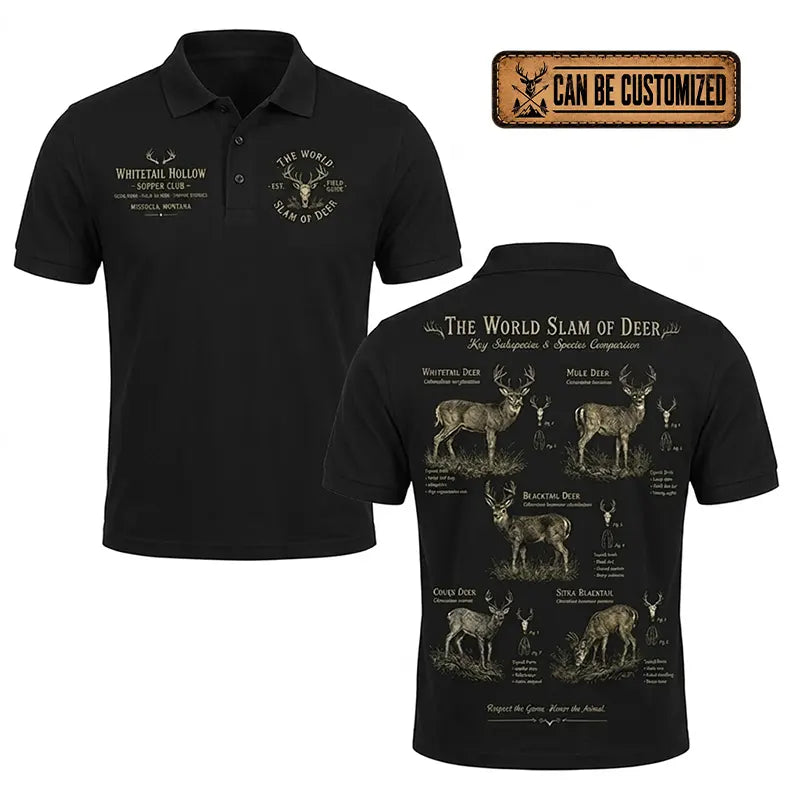
For hunters who want to support conservation while looking sharp, our Deer Skull Camo Polo Shirt blends field-ready style with everyday wear

Deer Skull Camo Polo - Shop at Fathom Thread
FAQ: Whitetail Deer Facts
What is the scientific name for a white-tailed deer?
The scientific name for a white-tailed deer is Odocoileus virginianus, first described by Eberhard August Wilhelm von Zimmermann in 1780. The genus name means "hollow-toothed" in Greek, and the species name refers to Virginia, where the type specimen was first documented.
Where do whitetail deer live?
Whitetail deer live across the entire Western Hemisphere - from southern Canada through the United States, Mexico, Central America, and into South America as far south as Bolivia. They inhabit forests, agricultural areas, suburban neighborhoods, and even tropical environments, making them one of the most widely distributed land mammals in the Americas.
How fast can a whitetail deer run?
A whitetail deer can sprint at speeds of up to 30-35 mph (48-56 km/h) and can leap fences over 8 feet high and distances of 30 feet in a single bound. Their long, powerful hind legs and lightweight build make them exceptionally agile runners.
How long do whitetail deer live?
In the wild, whitetail deer typically live 4-6 years in hunted populations and up to 10-12 years in protected areas. Captive whitetails can live 15 years or more. The oldest recorded wild whitetail lived to approximately 14.5 years.
What do whitetail deer eat?
Whitetail deer are herbivorous ruminants that eat a varied diet including woody browse (twigs, leaves, bark), forbs (broadleaf plants), mast (acorns, nuts), grasses, agricultural crops (corn, soybeans), fruits, berries, and fungi. They consume approximately 6-8 pounds of food per day.
What animals prey on whitetail deer?
Gray wolves, mountain lions, coyotes, black bears, and bobcats all prey on whitetail deer, though the impact varies heavily by region and by the deer's age. Coyotes and bobcats mainly target fawns, while wolves and mountain lions can take healthy adults. In most of the modern whitetail range, regulated human hunting causes far more adult mortality than any natural predator.
How many subspecies of whitetail deer exist?
Most authorities recognize approximately 38 subspecies of Odocoileus virginianus, including around 16 in North America and 22 in Central and South America. However, recent genetic research suggests some of these may represent gradual geographic variation rather than distinct taxonomic units.
Celebrating the Whitetail - Deer-Inspired Apparel
The whitetail deer isn't just a biological marvel - it's a cultural icon. From deer camp traditions to wildlife art to the gear we wear, the whitetail has earned its place at the center of North American outdoor culture.
Whether you're heading out for early-season archery, working around the property, or just want to show your love for North America's most popular game animal, Fathom Thread has you covered. Explore our full range of deer-themed apparel, including tees, hoodies, and polos designed for people who know the difference between a 10-pointer and a mule deer fork.
Need to round out your entire look? Check out our hunting shirts collection for designs that work just as well at the tailgate as they do in the stand. And if you're planning your seasonal wardrobe, our guides on essential deer hunting shirts and seasonal deer hunting outfit combinations will help you dial in the perfect setup.
The whitetail has survived ice ages, market hunting, habitat loss, and disease - and thrived through it all. Wearing deer-inspired gear isn't just a style choice. It's a tribute to one of nature's most resilient survivors.